Field goals are often described as a contest between a kicker’s leg, the snap, the hold, the rush, and the weather. Yet one piece of equipment quietly shapes the entire event: the goal post. In the NFL, goal posts do not merely mark the target; their dimensions, placement, visibility, and relationship to stadium conditions influence both field goal accuracy and coaching strategy in meaningful ways.
TLDR: NFL goal posts can affect field goal accuracy, but not because they vary dramatically from stadium to stadium; league rules standardize their width, height, and placement. Their main impact comes through how kickers perceive the target, how wind behaves around the uprights, and how coaches calculate risk at different distances. Modern NFL strategy treats field goals as probability-based decisions, and the goal posts are central to those calculations. Even small changes in visibility, angle, or environmental conditions can influence whether a team attempts a kick, punts, or goes for it on fourth down.
The Standard NFL Goal Post: A Precise Target
An NFL goal post is a highly regulated structure. The crossbar is 10 feet above the ground, and the uprights are 18 feet 6 inches apart. The uprights extend upward from the crossbar, creating the familiar yellow target at the back of each end zone. This standardization matters because kickers and special teams coaches rely on consistent geometry when developing technique, judging angles, and evaluating range.
Although the target may appear large from a television camera, it becomes significantly smaller from a kicker’s perspective as distance increases. A 35-yard field goal is usually routine for a professional kicker, but a 55-yard attempt requires a combination of power, launch angle, spin control, and directional precision. The farther the ball travels, the more any small technical error is magnified.
The goal posts define the margin for error. A ball struck only slightly off line may still pass inside the uprights from 25 yards. From 55 yards, that same directional error can produce a miss by several feet. In this sense, the goal posts do not change, but the effective difficulty of the target does.
Why Width Matters More Than It Seems
The NFL’s 18-foot-6-inch width is narrower than many casual fans realize. In college football, the goal posts are the same width today, but at lower levels of football, wider posts are often used. Historically, different levels of play have used different widths, and a wider target naturally increases kicking success rates.
For NFL kickers, the narrow uprights force elite consistency. The difference between a successful kick and a miss can be a matter of inches. This is particularly important because the ball does not simply travel in a perfectly straight line. It may draw or fade depending on the kicker’s mechanics, foot contact, ball rotation, wind, and air density.
For example, a right-footed kicker may naturally produce a slight right-to-left movement on certain kicks. Coaches and specialists account for this by choosing a target line. Rather than aiming exactly at the center of the posts, a kicker might aim slightly inside one upright and allow the ball’s movement to bring it toward the middle.
This means the goal posts influence accuracy in two ways:
- Objectively: They establish the legal scoring area and determine whether the kick counts.
- Psychologically: They give the kicker a visual frame that affects aim, confidence, and routine.
Placement at the Back of the End Zone
In the NFL, the goal posts are located on the end line at the back of the end zone. This was not always the case. Earlier in football history, goal posts stood on the goal line, which made shorter field goals easier and created a different strategic environment. Moving the posts to the back of the end zone increased the effective distance of attempts and changed how teams valued field position.
Today, a field goal attempt is measured from the line of scrimmage plus approximately 17 yards: 10 yards for the end zone and about 7 yards for the snap and hold. So, if a team is at the opponent’s 30-yard line, the field goal attempt is roughly 47 yards. This simple calculation heavily affects fourth-down decisions.
Because the posts are at the back of the end zone, coaches must think differently once they cross midfield. A team may be “in range” for a strong-legged kicker at the 35-yard line, but that still means a long attempt of about 52 yards. If the conditions are poor, the coach may instead choose to punt or attempt a fourth-down conversion.
Visibility and Depth Perception
Goal posts are painted bright yellow for a practical reason: visibility. Kickers need to pick up the uprights quickly and clearly, especially in large stadiums filled with moving backgrounds, crowd colors, shadows, video boards, and weather effects. While the dimensions are consistent, the visual environment is not.
Some stadiums have open ends, unusual lighting, or background structures that can affect depth perception. A kicker looking toward a bright sky, a dark crowd, or a partially shaded end zone may perceive the target differently. This does not make a professional kicker helpless, but it can add another variable to an already demanding task.
Experienced kickers often develop pre-kick visual routines. They may identify a specific point between the uprights, focus on the holder’s spot, and avoid staring too long at the posts. The goal is to combine a trusted mechanical process with enough visual reference to align the kick correctly.
Wind, Stadium Design, and the Uprights
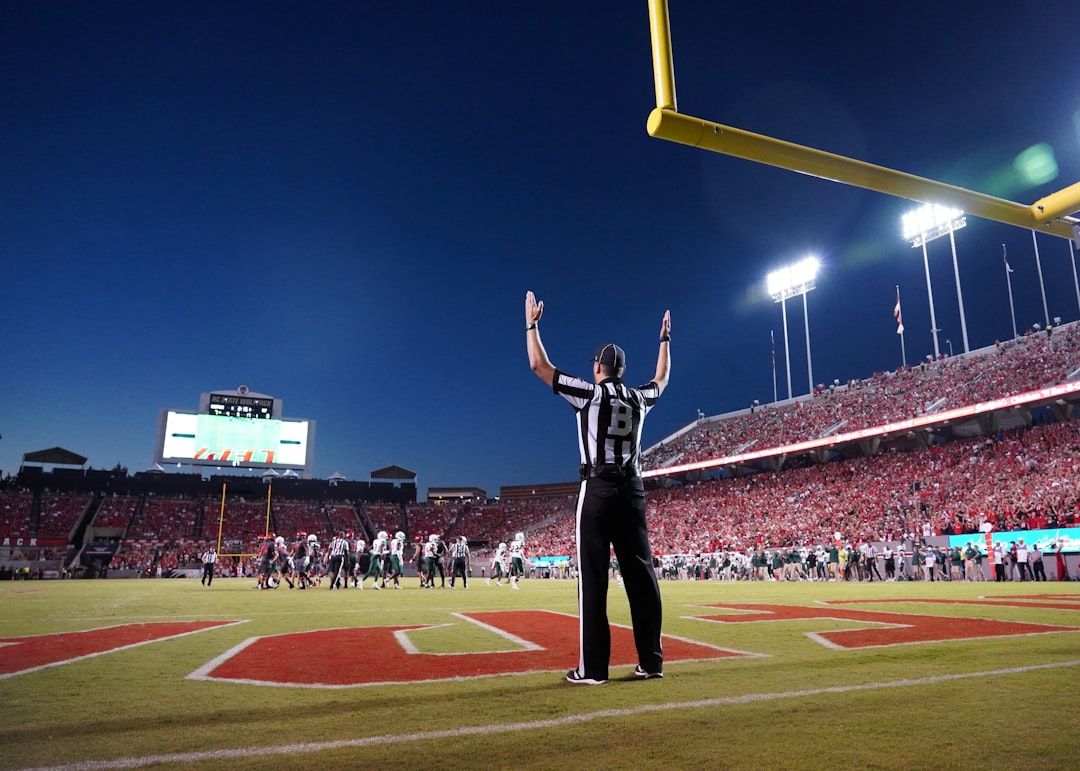
Wind is one of the most important environmental factors in field goal accuracy. The goal posts themselves do not create the wind, but they help reveal it. Fans often see flags on top of the uprights moving in different directions, which can indicate swirling wind patterns inside the stadium.
Open-air stadiums can produce unpredictable conditions. Wind may enter through gaps, circulate around seating bowls, or shift direction near the end zone. A kicker might feel one breeze at field level while the ball encounters a different current as it rises toward the crossbar. This is why a kick can start online and then drift late.
Coaches and kickers study these patterns during warmups. They observe how practice kicks travel toward each set of posts and whether one end of the field is more favorable than the other. In some games, choosing direction after the coin toss or overtime coin toss can meaningfully affect kicking strategy.
The Crossbar and Launch Angle
Most fans focus on whether the ball passes between the uprights, but the crossbar is equally important. A successful field goal must clear the bar, which sits 10 feet high. On short kicks, clearing the line of scrimmage and avoiding a block are usually bigger concerns than clearing the crossbar. On longer kicks, however, the kicker must balance height and distance.
A higher kick is safer against the rush but may sacrifice distance. A lower kick may carry farther but increases the chance of being blocked. The goal post therefore influences technique indirectly: the kicker must launch the ball on a trajectory that clears defenders, clears the crossbar, and still stays inside the uprights.
This balance becomes critical on attempts beyond 50 yards. A kicker may strike the ball with slightly lower trajectory to maximize distance, especially in cold weather when the ball does not travel as well. But that tactical adjustment reduces the error margin near the line of scrimmage and can expose the attempt to a block.
How Goal Posts Shape Coaching Strategy
Modern NFL coaches increasingly rely on probability models. They compare the expected value of a field goal attempt with the expected value of punting or going for it on fourth down. The goal posts are central to this analysis because they define the scoring target and, by extension, the likelihood of success from each distance.
A coach considers several factors before attempting a field goal:
- Distance: Accuracy declines as attempts get longer, especially beyond 50 yards.
- Kicker strength: Some kickers have reliable range from 55 yards or more; others do not.
- Weather: Wind, rain, snow, and temperature can reduce accuracy and distance.
- Game situation: Score, time remaining, and timeout situation affect risk tolerance.
- Field position consequences: A missed long field goal gives the opponent strong field position.
- Opponent strength: Against an elite offense, giving away field position can be especially costly.
Even when a kicker has enough leg, the narrow target makes long attempts far from automatic. A missed 57-yard attempt may hand the opponent the ball near midfield. That risk may push a coach toward a punt or an aggressive fourth-down play.
Hash Marks and Kicking Angles
The position of the ball between the hash marks also affects strategy. NFL hash marks are relatively close together compared with college football, which reduces extreme kicking angles. Still, a kick from the left hash is not identical to a kick from the right hash, particularly at shorter distances where the angle to the uprights is sharper.
Teams frequently manage the final plays before a field goal attempt to place the ball where the kicker prefers it. A right-footed kicker may prefer one hash, while another kicker may prefer the middle. These preferences are not superstition; they reflect comfort, approach steps, sightline, and ball flight.
This is a subtle but important way the goal posts influence strategy. On third down late in a half, an offense may run a conservative play not merely to gain yards but to center the ball. The goal is to improve the kicker’s visual angle and reduce complexity.
Psychological Pressure and the Visible Target
Field goal kicking is intensely psychological. The goal posts stand as a bright, unforgiving measure of success or failure. Unlike many football plays, the outcome is instantly obvious. A kick is either good or no good, and the uprights make that judgment public.
Professional kickers train to narrow their focus. They often emphasize process over outcome: same steps, same breathing, same timing, same swing. However, the visual presence of the posts can still affect pressure, especially in game-winning situations. A narrow miss that strikes an upright can be mentally difficult because it shows how close success was.
The sound of a ball hitting the upright is one of the most dramatic moments in football. From a technical standpoint, it means the kicker was nearly accurate enough. From a strategic standpoint, it reminds coaches that even high-probability kicks carry uncertainty.
Could Changing the Goal Posts Change the NFL?
If the NFL widened the uprights, field goal percentages would likely rise, especially from longer distances. Coaches might attempt more long kicks, and games could feature more scoring from stalled drives. If the league narrowed the uprights, the opposite would likely occur: fewer long attempts, more fourth-down tries, and greater emphasis on touchdowns.
Raising the crossbar would also affect strategy by forcing kickers to use higher trajectories, potentially reducing range. Moving the posts forward would make field goals easier and would dramatically alter red-zone decision-making. These possibilities show that goal post design is not a trivial detail. It is part of the competitive balance of the sport.
The current NFL dimensions have helped create a strategic middle ground. Field goals are common enough to matter, but difficult enough to require judgment. Elite kickers are valuable, yet coaches cannot treat every drive past midfield as guaranteed points.
The Bottom Line
Can NFL goal posts impact field goal accuracy and strategy? Yes, but mostly through standardized difficulty, visual perception, environmental interaction, and decision-making incentives. The posts do not vary in width from week to week, but they frame every kick and define the risk-reward calculation behind countless coaching decisions.
For kickers, the uprights represent a precise target that becomes more demanding with distance, wind, angle, and pressure. For coaches, they help determine whether a fourth down is a kicking opportunity, a punting situation, or a chance to keep the offense on the field. In a league where games are often decided by three points or fewer, the goal posts are not passive scenery. They are a central part of how NFL football is played, measured, and won.